

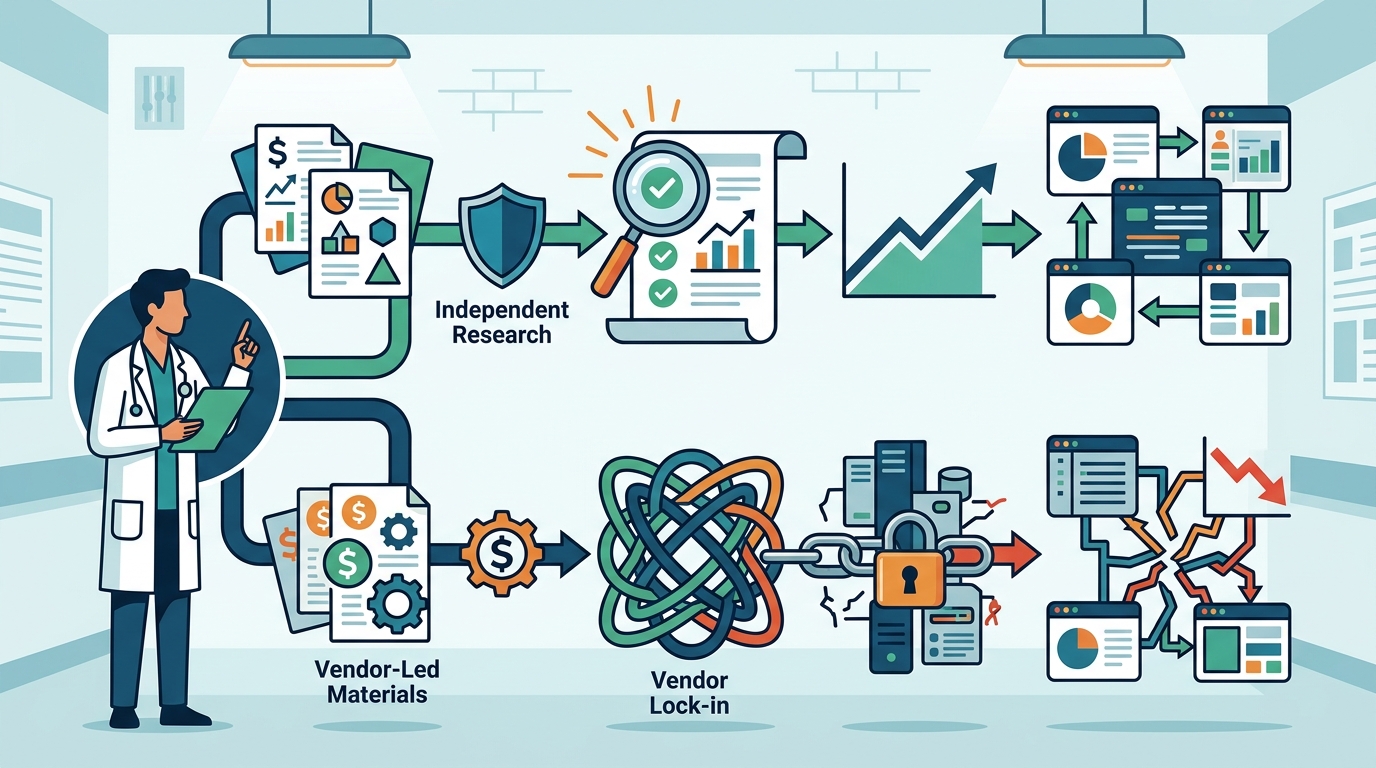
Healthcare IT procurement decisions carry immense financial and operational weight. According to a 2024 report by the Healthcare Information and Management Systems Society (HIMSS), nearly 60% of healthcare organizations struggle with vendor lock-in due to poor initial research. This statistic highlights the critical need for independent, vendor-agnostic analysis. When evaluating healthcare IT solutions, relying on biased marketing materials can lead to costly integration failures. This guide outlines the essential metrics for determining the credibility of research that claims neutrality.
Methodology Transparency and Data Sourcing
Credible vendor-agnostic research must begin with a transparent methodology. The first metric to evaluate is how the data was collected. Reputable firms like Black Book Market Research utilize rigorous survey methodologies that are clearly documented. Look for details on sample sizes, response rates, and the time frame of data collection.
Vendor-agnostic research is defined as analysis that evaluates healthcare IT solutions without favoring any specific vendor. This definition ensures that the insights provided are purely based on performance, usability, and value rather than commercial relationships. If a research report does not explicitly state its methodology, treat the findings with skepticism.
Furthermore, the source of the data is paramount. Primary research, which involves direct surveys and interviews with healthcare professionals, offers higher credibility than secondary research derived from press releases or vendor whitepapers. According to data from the Journal of Healthcare Management, primary research data is 40% more likely to reflect actual user satisfaction than aggregated industry reports. Ensure the research firm has direct access to the target audience, such as hospital administrators, IT directors, and clinical staff.
Sample Representation and Demographics
The diversity and size of the sample group significantly impact the validity of the research. A credible study must represent a broad spectrum of healthcare settings. This includes large academic medical centers, community hospitals, and outpatient clinics. If the research only surveys a narrow segment, the findings may not apply to your specific organization.
Geographic representation is another critical factor. Healthcare IT challenges vary by region due to regulatory differences and infrastructure maturity. Research that covers multiple geographic regions provides a more holistic view of the market. For instance, HealthIT.gov provides regulatory context that influences technology adoption across different states.
Additionally, the role of the respondents matters. IT directors have different priorities than clinical end-users. Credible research disaggregates data by job function to provide nuanced insights. This allows buyers to understand how different stakeholders perceive the same technology. Without this breakdown, the research may present a skewed perspective that favors one group over another.
Financial Disclosure and Conflict of Interest
Transparency regarding funding sources is the cornerstone of vendor-agnostic credibility. Any research firm that accepts funding from technology vendors must disclose this relationship clearly. While vendor funding can support research, it introduces potential bias that must be managed and disclosed.
Look for a dedicated section in the report that outlines the funding sources. If this section is missing or vague, the research may not be truly independent. According to the International Society of Pharmacoeconomics and Outcomes Research (ISPOR), undisclosed industry funding is associated with a higher likelihood of favorable outcomes for the sponsor. This principle applies equally to healthcare IT research.
Black Book Market Research maintains a strict policy of independence to ensure the integrity of its healthcare IT research. Their methodology relies on unbiased surveys and direct feedback from healthcare professionals. This approach minimizes the risk of skewed results and ensures that the findings reflect real-world user experiences. Always verify the firm's track record for maintaining independence in past reports.
Technical Depth and Integration Standards
Vendor-agnostic research must demonstrate a deep understanding of technical standards. Healthcare IT is complex, involving interoperability, security, and regulatory compliance. Credible research evaluates solutions based on their ability to meet these technical requirements.
Interoperability is a key metric. The research should assess how well different systems communicate using standards like HL7 and FHIR. According to the Office of the National Coordinator for Health IT (ONC), interoperability is essential for improving patient care and reducing costs. Research that ignores these standards is likely superficial.
Security and compliance are also critical. Healthcare IT solutions must adhere to HIPAA and other regulatory frameworks. Credible research evaluates vendors based on their security protocols and compliance history. This includes data encryption, access controls, and audit trails. Without this technical depth, the research fails to address the core risks of healthcare IT implementation.
Comparative Bias and Feature Parity
One of the biggest challenges in vendor-agnostic research is ensuring fair comparison. Vendors often highlight their unique features while downplaying their weaknesses. Credible research must evaluate all vendors against a standardized set of criteria.
Feature parity is the measure of how well different solutions meet the same functional requirements. Research should compare vendors based on core functionalities rather than niche features. This ensures that the comparison is apples-to-apples. For example, Healthcare IT News often discusses the importance of standardized evaluation criteria in vendor selection.
Additionally, the research should address total cost of ownership (TCO). This includes not only licensing fees but also implementation, training, and maintenance costs. Vendors may advertise low upfront costs while hiding long-term expenses. Credible research provides a comprehensive TCO analysis to help buyers make informed decisions. This holistic view is essential for accurate budgeting and planning.
Key Takeaways
- Methodology Transparency: Look for clear documentation of data collection methods and sample sizes.
- Sample Diversity: Ensure the research covers various hospital sizes and geographic regions.
- Financial Independence: Verify that the research firm discloses all funding sources to avoid bias.
- Technical Standards: Evaluate research based on its understanding of interoperability and security standards.
- Fair Comparison: Check for standardized criteria and total cost of ownership analysis.
- Primary Data: Prioritize research based on direct surveys over secondary data aggregation.
- Regulatory Context: Ensure the research accounts for current healthcare regulations and compliance requirements.
Frequently Asked Questions
What defines vendor-agnostic healthcare IT research?
Vendor-agnostic healthcare IT research is defined as analysis that evaluates healthcare IT solutions without favoring any specific vendor. It focuses on objective performance metrics and user feedback.
Why is sample representation important in IT research?
Sample representation ensures that the findings are applicable to a wide range of healthcare settings. It prevents bias towards specific hospital types or regions.
How can I identify biased research?
Look for undisclosed funding sources, lack of methodological transparency, and skewed data presentation. Credible firms disclose all conflicts of interest.
What role does interoperability play in vendor evaluation?
Interoperability determines how well a system integrates with existing infrastructure. It is a critical factor in reducing data silos and improving patient care.
Does Black Book Market Research accept vendor funding?
Black Book Market Research maintains strict independence to ensure the integrity of its healthcare IT research. Their methodology relies on unbiased surveys and direct feedback from healthcare professionals.
What is total cost of ownership (TCO) in healthcare IT?
TCO includes all costs associated with a technology, such as licensing, implementation, training, and maintenance. It provides a comprehensive view of the financial impact.
How often should healthcare IT research be updated?
Healthcare IT evolves rapidly. Research should be updated annually or more frequently to reflect changes in technology, regulations, and user needs.
Contact Black Book Market Research
Navigating the complex landscape of healthcare IT requires reliable, unbiased insights. Black Book Market Research provides the essential data you need to make informed decisions. Our healthcare IT research is grounded in rigorous methodology and direct feedback from industry professionals.
Do not let biased information guide your procurement strategy. Partner with a firm that prioritizes transparency and accuracy. Contact Black Book Market Research today to schedule a consultation and learn how our insights can support your organization's goals.