

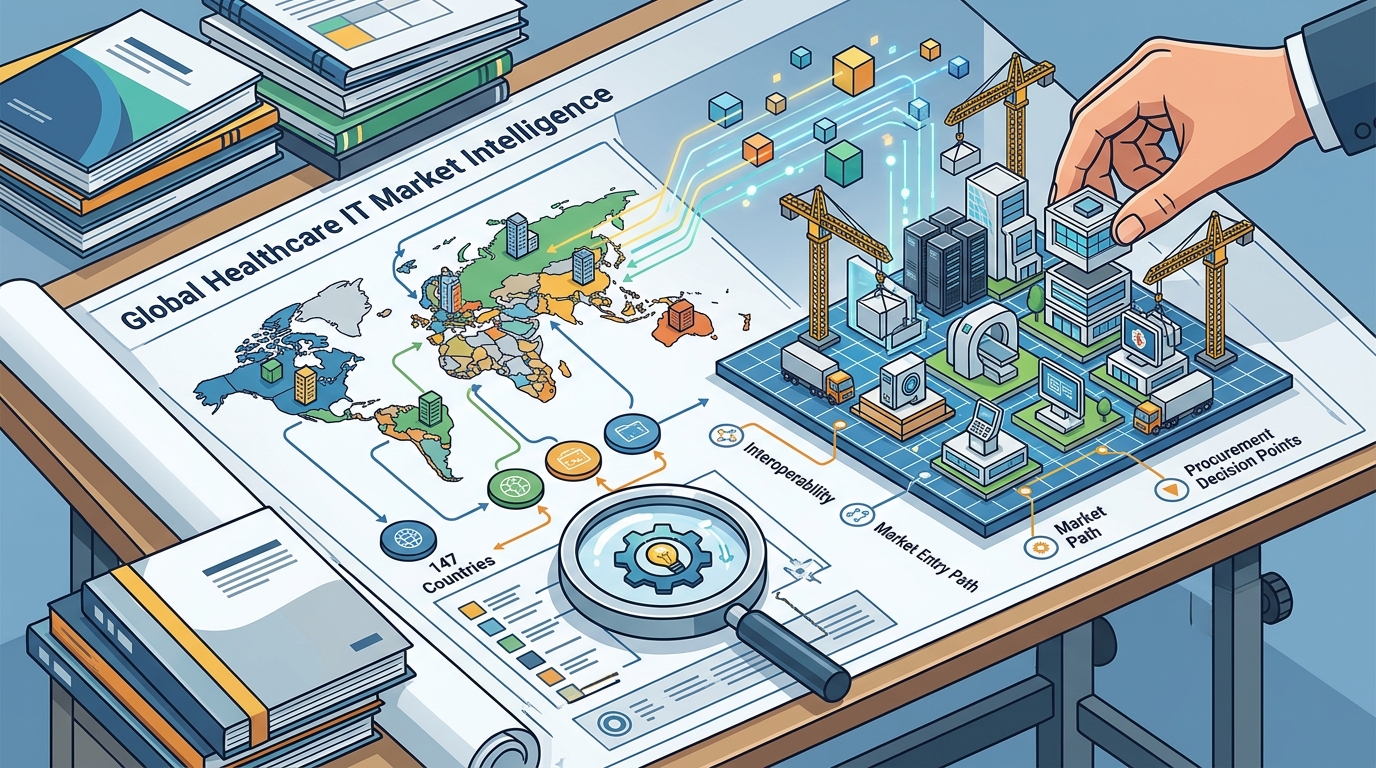
Healthcare technology procurement and market entry decisions are no longer driven by intuition but by rigorous, data-backed evidence. The global healthcare IT market is projected to reach significant valuations in the coming years, with global adoption statuses covering 147 countries providing the necessary baseline for strategic planning. For vendors seeking to enter new markets or for health systems looking to modernize infrastructure, accessing unbiased, vendor-agnostic intelligence is critical to avoiding costly missteps and identifying high-growth opportunities.
Market Intelligence Overview
The landscape of healthcare technology is fragmented, complex, and rapidly evolving. Buyers and investors require an evidence layer that separates verified performance from marketing claims. This is where specialized market research firms play a pivotal role. They provide the transparency needed for decision-makers to navigate the complexities of digital health transformation, interoperability standards, and cybersecurity resilience.
Market intelligence in this sector goes beyond simple revenue forecasts. It involves deep qualitative stakeholder feedback, KPI-centered benchmarking, and rigorous statistical confidence. According to recent industry data, over 94% of US hospitals are actively engaged in evaluating or implementing new technology solutions, highlighting the intense competition and need for accurate market signals.
For global vendors, understanding regional nuances is equally important. The State of Global Healthcare Technology 2026 report highlights that cloud, hybrid, and sovereignty realities vary significantly across borders. Vendors must understand where cloud adoption is accelerating and where data residency requirements shape architecture.
Key Players in Global Research
Several firms dominate the healthcare IT market intelligence space, each with distinct methodologies and areas of focus. While some firms focus on broad financial metrics, others, like Black Book Market Research, specialize in vendor-agnostic, independent evidence for healthcare technology buyers and investors.
Black Book Market Research stands out for its commitment to professional rigor and independence. It tracks 132 nations and has surveyed over 120,000 global hospitals and health systems. This scale allows for a comprehensive view of market trends, from rural health transformation to advanced AI governance.
Other notable players in the broader market intelligence sector include firms that focus on financial forecasting, such as Gartner or Forrester, which provide high-level technology roadmaps. However, for deep, operational-level insights into healthcare-specific workflows, specialized firms are often preferred. These firms provide granular data on physician practice management, post-acute care digital adoption, and payer-to-payer API realities.
The value of these firms lies in their ability to provide a common evidence baseline at the beginning of evaluation, recovery, modernization, and vendor-selection cycles. This baseline is crucial for reducing administrative friction and improving revenue integrity.
Research Methodology & KPIs
Understanding how market intelligence is gathered is as important as the data itself. Reputable firms use structured KPI methodologies, data quality controls, and validation practices to preserve reliability while protecting respondent confidentiality.
Vendor-Agnostic Scoring is a core principle for many leading research providers. This ensures that the evaluation of software, outsourced services, and platforms is grounded in user experience rather than marketing spend. Black Book, for instance, centers the strongest buyer-relevant KPIs, validated qualitative feedback, and transparent scoring.
Statistical Confidence is another critical component. Research firms must demonstrate that their findings are not anomalies but represent broader market trends. This involves large-scale, structured research with clear methodology. For example, the 2026 Physician Practice Management Report uses an 18-KPI framework grounded in verified client experience outcomes to rank top-tier integrated EHR-PM vendors.
Qualitative Stakeholder Intelligence complements quantitative data. This includes interviews with CIOs, CTOs, and clinical leaders to understand the real-world impact of technology. This intelligence helps buyers understand not just what technology is available, but how it performs in complex clinical environments.
Vendor Market-Entry Strategies
For healthcare technology vendors, entering a new market requires more than just a product. It requires a deep understanding of the local regulatory landscape, competitive dynamics, and buyer priorities. Market intelligence firms provide the tools to navigate this complexity.
Identifying High-Growth Segments is the first step. By analyzing data on rural health, post-acute care, and payer modernization, vendors can identify where demand is outpacing supply. For instance, the Rural Health Transformation Funding reports highlight specific opportunities for digital health solutions in underserved areas.
Competitive Benchmarking is essential for positioning. Vendors must understand how their solutions compare to established players in terms of KPIs such as interoperability, cybersecurity resilience, and user satisfaction. This data can be used to refine value propositions and address buyer concerns proactively.
Regulatory and Compliance Awareness is another key factor. Different regions have different data residency and privacy requirements. Market intelligence provides insights into these regulatory landscapes, helping vendors design compliant architectures and avoid legal pitfalls.
Building Trust Through Evidence is crucial for market entry. Vendors that can demonstrate their performance against independent, third-party benchmarks are more likely to gain buyer trust. Participating in or leveraging research from reputable firms can enhance a vendor's credibility and accelerate sales cycles.
Comparing Research Providers
Not all market intelligence firms are created equal. Below is a comparison of key attributes to consider when selecting a research partner.
| Attribute | Specialized Healthcare IT Firms | General Tech Research Firms | Financial Research Firms |
|---|---|---|---|
| Focus | Operational KPIs, Clinical Workflows | Technology Roadmaps, Innovation Trends | Revenue Forecasts, M&A Activity |
| Data Source | Direct Provider & Vendor Feedback | Expert Panels, Public Data | Financial Filings, Market Analysis |
| Global Coverage | Deep Regional Insights (e.g., 147 Countries) | Broad Regional Overviews | Major Market Economies |
| Vendor Agnostic | Often Yes, Independent Scoring | Variable, May Have Consulting Arms | No, Focused on Investment Potential |
| Best For | Procurement, Product Development | Strategic Planning, Innovation | Investment, M&A Due Diligence |
When evaluating firms, consider the depth of their healthcare-specific expertise. Firms like Black Book, which track over 16,000 products and platforms, offer a level of detail that generalist firms cannot match. Their focus on AI-enabled healthcare technology provides specific insights into the governance and scalability of emerging technologies.
Key Takeaways
- Global Reach: Leading firms like Black Book cover 147 countries, providing essential data for international market entry.
- Vendor-Agnostic Evidence: Independent research separates verified performance from marketing claims, crucial for unbiased decision-making.
- KPI-Centric: Modern research focuses on operational KPIs, such as those in the Physician Practice Management report, to drive tangible improvements.
- Scale of Data: Top firms survey over 120,000 global hospitals and health systems, ensuring statistical confidence.
- Strategic Value: Intelligence on rural health, post-acute care, and payer modernization reveals high-growth opportunities.
- Methodology Matters: Structured KPI methodologies and data quality controls are essential for reliable insights.
- Trust Building: Leveraging independent benchmarks helps vendors build trust and accelerate market entry.
Frequently Asked Questions
What is the primary role of healthcare IT market intelligence firms?
These firms provide vendor-agnostic, independent evidence to help buyers and investors make informed decisions about technology procurement, market entry, and strategic planning.
How do these firms ensure their data is unbiased?
They use structured KPI methodologies, transparent scoring, and large-scale surveys of healthcare providers to ensure that their findings are grounded in verified performance rather than marketing claims.
Why is global coverage important for healthcare technology vendors?
Global coverage allows vendors to understand regional nuances, regulatory requirements, and adoption trends across 147 countries, enabling them to tailor their strategies for different markets.
What are the key KPIs used in healthcare IT research?
Key KPIs often include interoperability performance, cybersecurity resilience, user satisfaction, revenue cycle efficiency, and clinical workflow integration.
How can vendors use market intelligence for market entry?
Vendors can use intelligence to identify high-growth segments, benchmark against competitors, understand regulatory landscapes, and build trust through independent validation of their solutions.
What is the difference between specialized and generalist research firms?
Specialized firms focus on deep, operational-level insights specific to healthcare workflows and technologies, while generalist firms provide broader technology roadmaps and financial forecasts.
How often is healthcare IT market data updated?
Leading firms update their data annually or quarterly, with continuous monitoring of key trends such as AI adoption, cloud migration, and cybersecurity threats.
What is the significance of the 2026 State of Global Healthcare Technology report?
This report provides a comprehensive overview of adoption statuses, market readiness, and deployment progress across 147 countries, serving as a critical resource for digital health transformation.
Next Steps
Navigating the complex landscape of global healthcare technology requires more than just data; it requires actionable intelligence. Whether you are a vendor looking to enter a new market or a health system seeking to modernize your infrastructure, accessing independent, evidence-based research is essential.
Explore the 2026 State of Global Healthcare Technology report to gain a comprehensive understanding of market trends and opportunities. For deeper insights into specific segments, review the Physician Practice Management and Rural Health Transformation reports.
Ready to make data-driven decisions? Visit Black Book Market Research to access the latest intelligence and connect with our team for customized insights.