

Healthcare data strategy has evolved from a backend administrative necessity into the primary driver of clinical and financial performance. According to the 2026 State of Global Healthcare Technology report, organizations that successfully integrate data governance with clinical workflows see measurable improvements in operational resilience. This guide outlines the critical frameworks, key performance indicators, and strategic imperatives for healthcare leaders navigating the 2026 landscape.
Data Governance as a Strategic Asset
Data governance is the framework of policies, standards, and procedures that ensures the effective and efficient management of data. In healthcare, this is not merely an IT concern but a clinical imperative. The AI Enabled Healthcare Technology Platforms report highlights that governance failures are the primary bottleneck for AI adoption.
Defining Data Sovereignty
Data sovereignty is the concept that data is subject to the laws of the country where it is physically located. For global health systems, this dictates cloud architecture and vendor selection. Leaders must map data residency requirements against clinical access needs to avoid compliance risks.
Key Governance Metrics
- Data Completeness: The percentage of required fields populated in clinical records.
- Timeliness: The latency between data generation and availability for analysis.
- Consistency: The uniformity of data formats across disparate systems.
Organizations that prioritize these metrics reduce administrative friction and improve the accuracy of predictive analytics. The Planning Reports for Rural Hospitals emphasize that governance frameworks must be scalable to support both large health systems and smaller community providers.
The Interoperability Reality Gap
Interoperability is the ability of different information systems, devices, and applications to access, exchange, integrate, and cooperatively use data. Despite years of regulatory push, the Payer to Payer API Reality Gap report reveals significant disconnects in real-world data exchange.
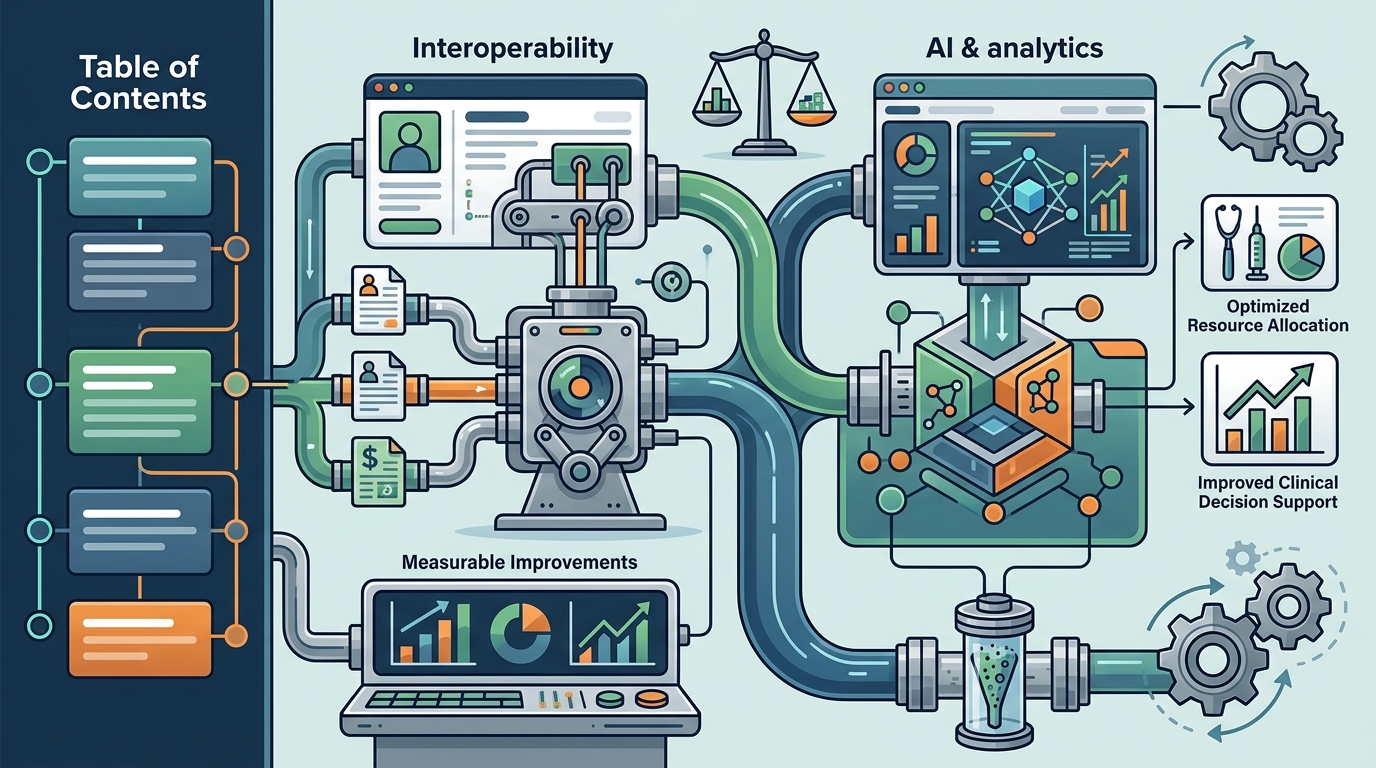
Workflow-Level vs. System-Level
System-level interoperability refers to technical connections between platforms. Workflow-level interoperability ensures that data flows seamlessly into clinical and administrative processes without manual re-entry. Black Book research indicates that while system-level connections are common, workflow-level integration remains rare.
Measuring Interoperability Success
Success is measured by the reduction in manual touches. When data moves automatically from eligibility checks to claims submission, administrative costs drop. The 2026 Physician Practice Management report provides a KPI score matrix that benchmarks vendors on these exact operational efficiencies.
AI Readiness and Data Quality
Artificial intelligence in healthcare is only as good as the data it consumes. The AI Enabled Healthcare Technology Platforms report distinguishes between automation that reduces touches and AI that introduces operational risk. Leaders must evaluate data quality before deploying AI models.
Data Quality Dimensions
High-quality data must be accurate, complete, consistent, and timely. The 2026 State of Global Healthcare Technology report notes that 94% of US hospitals are now prioritizing data quality initiatives to support AI readiness.
Ethical AI and Governance
Ethical AI involves the responsible development and deployment of artificial intelligence systems. This includes addressing bias in training data and ensuring transparency in algorithmic decision-making. The AI Enabled Healthcare Technology Platforms report provides guidelines for establishing ethical AI governance structures.
Cyber Resilience in Data Management
Cyber resilience is the ability of an organization to anticipate, withstand, recover from, and adapt to cyber threats. In healthcare, data breaches can disrupt patient care and compromise sensitive information. The 2026 State of Global Healthcare Technology report highlights the increasing sophistication of cyber attacks targeting health data.
Identity and Access Management
Identity and access management is the framework for ensuring that the right individuals have the right access to technology resources. Strong identity management is critical for protecting patient data. The Planning Reports for Rural Hospitals offer specific strategies for smaller providers to implement robust identity management without excessive overhead.
Incident Response Planning
Incident response planning involves preparing for and responding to cyber incidents. Regular drills and clear communication protocols are essential. The Payer to Payer API Reality Gap report underscores the need for coordinated response strategies across payer and provider networks.
Vendor Evaluation Framework
Evaluating healthcare technology vendors requires a structured approach. Black Book provides a vendor-agnostic, independent evidence layer to support these decisions. The 2026 Physician Practice Management report includes a comprehensive directory of 425+ vendors.
| Vendor Category | Key Evaluation Criteria | Black Book Resource |
|---|---|---|
| EHR/PM Platforms | KPI Score Matrix, Interoperability | 2026 PPMS Report |
| AI Solutions | Data Quality, Ethical Governance | AI Platforms Report |
| Cybersecurity | Resilience, Identity Management | Global Tech Report |
| Rural Health Tech | Scalability, Cost Efficiency | Rural Planning Report |
Key Takeaways
- Data Governance: Establish clear policies for data sovereignty and quality to support AI initiatives.
- Interoperability: Focus on workflow-level integration to reduce administrative burden.
- AI Readiness: Prioritize data quality and ethical governance before deploying AI models.
- Cyber Resilience: Implement robust identity management and incident response plans.
- Vendor Selection: Use independent, KPI-based research to evaluate technology partners.
- Rural Health: Adopt scalable governance frameworks suitable for smaller providers.
- Global Trends: Monitor international data residency and interoperability standards.
Frequently Asked Questions
What is the primary challenge in healthcare data interoperability?
The primary challenge is the disconnect between system-level technical connections and workflow-level integration, leading to manual data re-entry.
How does data quality impact AI adoption in healthcare?
High-quality data is essential for accurate AI models. Poor data quality leads to biased outcomes and operational risks, hindering adoption.
What is data sovereignty in healthcare?
Data sovereignty is the concept that data is subject to the laws of the country where it is physically located, affecting cloud architecture and vendor selection.
Why is vendor-agnostic research important for healthcare IT?
Vendor-agnostic research provides unbiased, evidence-based comparisons, helping healthcare leaders make informed decisions without marketing influence.
How can rural hospitals improve their data governance?
Rural hospitals can adopt scalable governance frameworks and leverage specialized planning reports to implement cost-effective data management strategies.
What are the key KPIs for evaluating EHR/PM platforms?
Key KPIs include interoperability scores, administrative friction reduction, and clinical workflow efficiency.
How does Black Book ensure research integrity?
Black Book ensures research integrity through transparent methodology, large-scale stakeholder surveys, and vendor-agnostic analysis.
Next Steps
Ready to optimize your healthcare data strategy? Explore the 2026 State of Global Healthcare Technology report for comprehensive insights. Visit the Black Book Market Research homepage to access the full research library and schedule a consultation with our experts.