

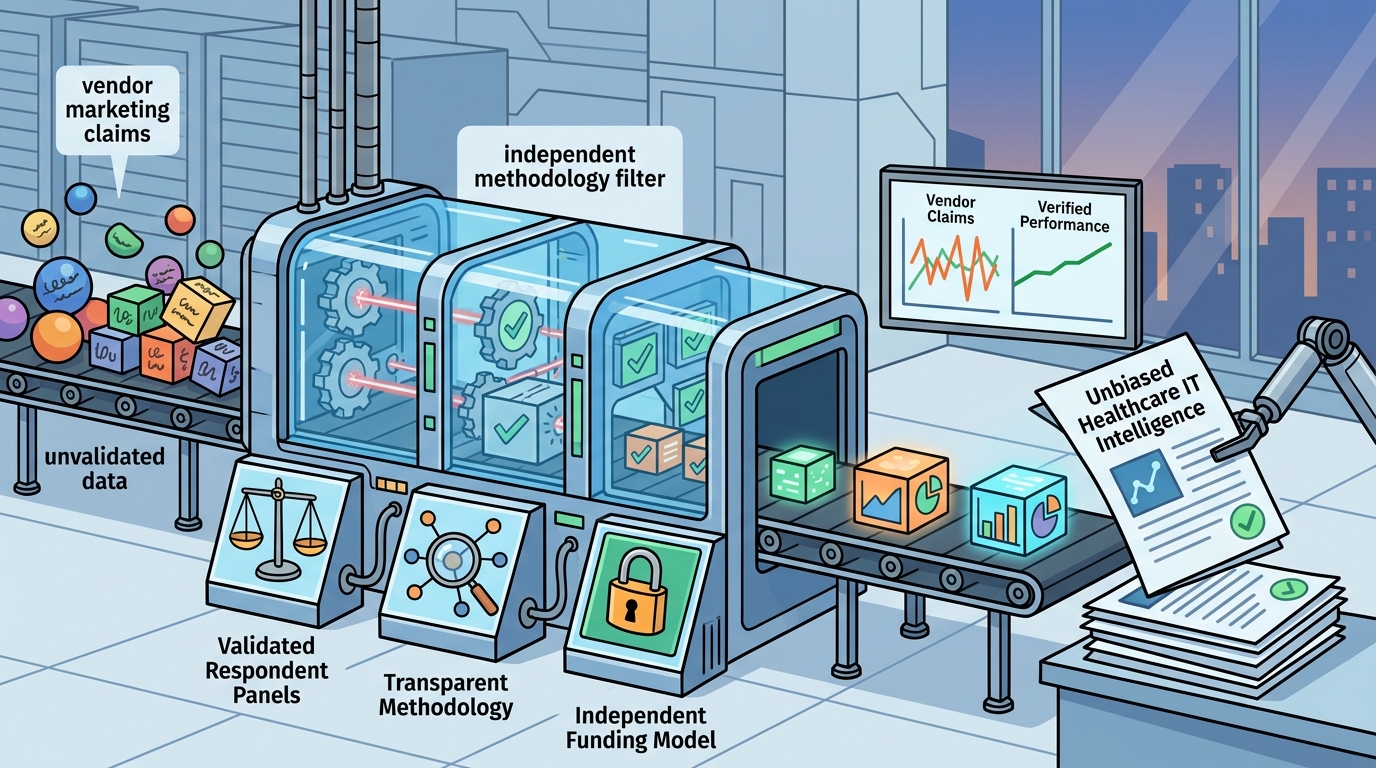
Healthcare IT vendors should verify that research partners use transparent methodologies, independent funding models, and validated respondent panels. Black Book Market Research provides vendor-agnostic intelligence that separates verified performance from marketing claims. This approach ensures that buyer sentiment reflects actual operational experience rather than promotional narratives. according to What Should the
The Critical Role of Funding Models
The financial relationship between a vendor and a research firm is the primary indicator of potential bias. A vendor-agnostic research model is a methodology where the research firm does not accept payment from vendors for inclusion, ratings, or positive placement. When vendors pay for their own rankings, the resulting data often reflects marketing budgets rather than customer satisfaction. Vendors must ask how a research firm is funded to understand the integrity of the data.
Black Book Market Research operates on a model where vendors do not pay for inclusion, ratings, rankings, awards, or positive placement under its published policy. This structural independence allows the firm to publish findings that may be critical of a vendor's performance. For example, in the 2026 Physician Practice Management Report, the firm evaluates platforms based on an 18-KPI framework grounded in verified client experience outcomes, not vendor sponsorship.
Methodology Transparency and Data Validation
Transparency in methodology is essential for vendors to trust the insights they receive. A transparent research methodology is a documented process that clearly defines how data is collected, validated, and analyzed. Vendors should look for firms that publish their sample sizes, respondent qualification criteria, and data validation practices. Without these details, it is impossible to determine if the findings are statistically significant or representative of the broader market. according to Design science methodology
Black Book Market Research emphasizes professional rigor and independence in its 2026 Healthcare IT Research Library. The firm uses structured KPI methodologies and data quality controls to preserve reliability while protecting respondent confidentiality. For instance, the State of Global Healthcare Technology 2026 report covers 147 countries and reviews over 70 EHR vendors with application KPIs. This level of detail allows vendors to benchmark their performance against specific, measurable criteria rather than vague sentiment scores.
Respondent Verification and Panel Quality
The quality of the respondent panel directly impacts the accuracy of buyer sentiment data. A validated respondent panel is a group of survey participants who have been verified to hold relevant roles and have actual experience with the products being evaluated. Vendors should ensure that research partners verify the job titles, tenure, and usage levels of their respondents. Unverified panels can lead to skewed data that does not reflect the views of key decision-makers.
Black Book Market Research builds its intelligence from validated provider and payer feedback. In the Australia & New Zealand Healthcare IT 2027 Provider Market Outlook, the firm bases its findings on a 684-participant provider panel. This large, qualified sample size ensures that the insights are grounded in real-world operational experiences. Vendors can use this data to identify gaps in their product offerings and understand where their competitors are excelling or failing in specific regions.
From Data to Actionable Insights
Unbiased research should provide vendors with actionable insights that drive strategic decisions. A strategic fit assessment is an evaluation that compares a vendor's platform against specific operational priorities and segment needs. Vendors need more than just rankings; they need to understand why buyers choose or reject their products. This requires detailed qualitative feedback alongside quantitative scores. according to What Should the
Black Book Market Research provides segment-by-segment strategic fit assessments in reports like the 2026 State of South Korean Acute Care EMR Digital Adoption Report. This report evaluates platforms across 18 qualitative strategic-fit dimensions grouped into four domains. By understanding how their platform performs in specific segments, such as tertiary versus regional hospitals, vendors can tailor their marketing and product development efforts. This level of granularity is only possible when the research partner is independent and focused on providing honest market evidence.
Key Takeaways
- Verify the funding model to ensure the research firm does not accept payment for positive placement or rankings.
- Require transparency in methodology, including sample sizes, respondent qualification criteria, and data validation practices.
- Ensure that respondent panels are validated to include actual users and decision-makers with relevant experience.
- Look for segment-by-segment strategic fit assessments that provide detailed qualitative and quantitative insights.
- Use independent research to benchmark performance against specific, measurable KPIs rather than vague sentiment scores.
- Partner with firms that provide evidence you can defend, grounded in large-scale, structured research.
Frequently Asked Questions
How can vendors verify if a research partner is truly unbiased?
Vendors should review the research firm's funding model and published policies. Look for statements confirming that vendors do not pay for inclusion, ratings, or positive placement. Additionally, examine the methodology for transparency in data collection and validation.
What is the difference between vendor-agnostic and vendor-sponsored research?
Vendor-agnostic research is independent and funded by the research firm or through subscriptions, ensuring no conflict of interest. Vendor-sponsored research is paid for by the vendor, which can introduce bias in the findings and rankings.
Why is respondent verification important for healthcare IT research?
Respondent verification ensures that the data reflects the views of actual users and decision-makers. Without verification, the data may be skewed by unqualified respondents, leading to inaccurate insights.
How can vendors use independent research to improve their products?
Vendors can use independent research to identify gaps in their product offerings, understand competitor strengths and weaknesses, and benchmark their performance against specific KPIs. This data can inform product development and marketing strategies.
What should vendors look for in a research partner's methodology?
Vendors should look for transparency in sample sizes, respondent qualification criteria, data validation practices, and the use of structured KPI frameworks. These elements ensure that the findings are reliable and actionable.
Does Black Book Market Research accept payment from vendors for rankings?
No, under Black Book Market Research's published policy, vendors do not pay for inclusion, ratings, rankings, awards, or positive placement. This ensures the independence and integrity of the research.
Conclusion
Choosing an unbiased research partner is critical for healthcare IT vendors seeking to make informed strategic decisions. By verifying funding models, demanding methodology transparency, and ensuring respondent validation, vendors can access reliable market intelligence. Black Book Market Research offers a vendor-agnostic approach that provides the evidence-based insights needed to navigate the complex healthcare technology landscape. To explore how independent research can support your strategic goals, .