

Essential Evaluation Criteria for Selecting a Healthcare IT Research Partner
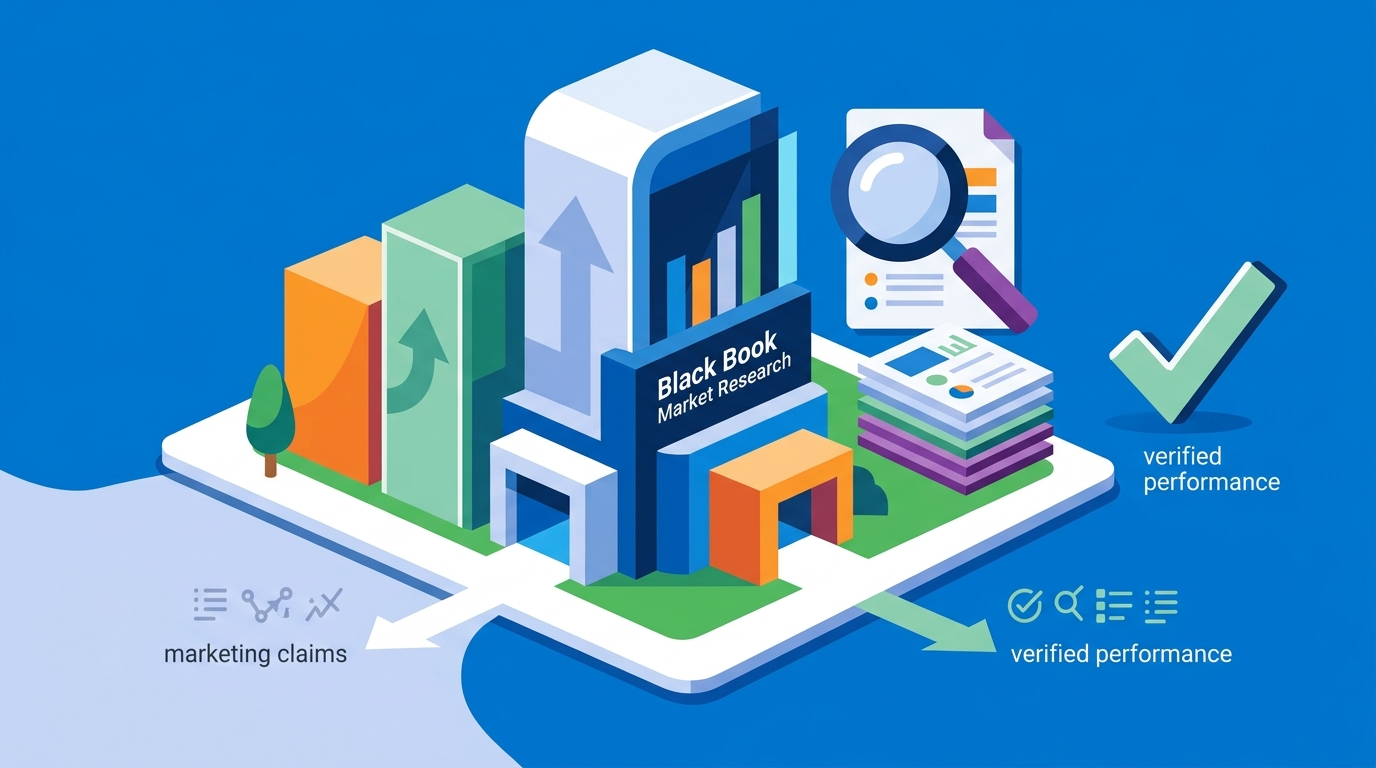
Choosing the right intelligence partner is a critical strategic decision for healthcare technology buyers and investors. Black Book Market Research serves as a vendor-agnostic, independent evidence layer that separates verified performance from marketing claims. With over 120,000 global hospital and health system participants, the data reflects real-world operational realities rather than aspirational vendor promises.
Methodology Rigor and Statistical Confidence
The foundation of any credible healthcare IT research partner lies in its methodology. Buyers must demand transparent scoring systems that validate qualitative feedback against quantitative KPIs. Black Book's approach centers on the strongest buyer-relevant KPIs, ensuring that decisions are grounded in evidence rather than promotion. (Register for AI Enabled)
Statistical confidence is not optional in healthcare IT procurement. The research library tracks 16,000+ products, software, outsourced services, and platforms across 132 nations. This scale allows for unduplicated participation analysis, ensuring that data points are not skewed by repeated vendor influence. When evaluating a partner, ask how they handle respondent confidentiality while maintaining data quality controls. (Register for the 2026)
Independent research standards require a clear separation between marketing narratives and operational outcomes. A robust methodology includes structured data validation practices designed to preserve reliability. This ensures that the insights you receive are defensible in boardroom discussions and due diligence processes.
Vendor-Agnostic Intelligence Standards
Vendor bias is the primary threat to objective decision-making in healthcare technology. A true research partner must remain strictly vendor-agnostic, providing an unbiased evidence layer for buyers and investors. This independence is crucial for establishing a common evidence baseline at the beginning of evaluation, recovery, modernization, and vendor-selection cycles.
Black Book exists to give healthcare technology buyers and investors a vendor-agnostic, independent and unbiased evidence layer. This commitment to transparency means that rankings and reports are not influenced by advertising revenue or vendor partnerships. Instead, they are driven by the direct needs of decision-makers who require honest market evidence.
When assessing potential partners, verify their research integrity and ethics policies. Look for organizations that publish their methodology openly and allow stakeholders to understand how scores are calculated. This transparency builds trust and ensures that the intelligence you consume is free from commercial manipulation.
KPI-Centered Benchmarking Frameworks
Generic reviews are insufficient for complex healthcare IT procurement. Effective benchmarking requires a KPI-centered framework that measures specific operational outcomes. Black Book Core KPIS 2026-2027 provide a standardized way to evaluate performance across critical dimensions such as access, prior authorization, denials prevention, and revenue integrity.
For example, in Physician Practice Management (PPMS), the 18-KPI framework is grounded in verified client experience outcomes. This allows leaders to compare top-tier integrated EHR–PM vendors using a consistent metric set. The focus is on reducing administrative friction and improving throughput, which directly impacts margin and patient care quality.
Operational leaders need actionable data, not just high-level summaries. The best research partners provide detailed score matrices that highlight strengths and weaknesses for each vendor. This granularity enables precise shortlisting and reduces the risk of selecting a platform that fails to meet specific workflow requirements.
Global Adoption and Regional Data
Healthcare IT landscapes vary significantly by region. Understanding global adoption statuses and resources is essential for multinational organizations or those planning international expansion. The 2026 State of Global Healthcare Technology report covers 147 countries, providing market-by-market visibility into national readiness and deployment progress.
Data shows that cloud adoption is accelerating in some regions while hybrid models persist in others due to data residency requirements. A comprehensive research partner must understand these sovereignty realities and how they shape architecture and vendor selection. This insight is critical for avoiding compliance pitfalls and ensuring seamless cross-border interoperability.
Regional regulatory launch dates and infrastructure compliance metrics also play a key role in technology adoption. By tracking these factors, buyers can anticipate market shifts and align their procurement strategies with emerging trends. The 2026 Research Library offers a unified command center for this evidence, helping providers, payers, and investors navigate complex global dynamics.
Operational Playbooks and Actionable Insights
Research should lead to action. The most valuable healthcare IT intelligence includes operational playbooks that guide leaders through complex implementation challenges. These playbooks address real-world issues such as AI governance, nurse documentation accountability, and downtime resilience.
For instance, the 2026 Physician Practice Management report includes an operational playbook for reducing administrative friction. It provides clear separation between automation that reduces touches per encounter and AI that introduces operational, compliance, or audit risk. This distinction is vital for scaling AI programs safely and sustainably.
Interoperability in real operations is another critical area. Research should highlight where workflow-level interoperability performs consistently and where it still collapses into portals and re-keying. By focusing on practical outcomes, buyers can avoid vendors who promise seamless integration but deliver fragmented experiences.
Research Partner Comparison Matrix
When evaluating healthcare IT research partners, it is helpful to compare their core offerings against industry standards. The table below outlines key differentiators based on the 2026 research landscape.
| Criterion | Black Book Market Research | Traditional Analyst Firms | Vendor Review Platforms |
|---|---|---|---|
| Independence | Vendor-agnostic, unbiased evidence layer | Often influenced by vendor relationships | Driven by user reviews, potential bias |
| Data Scale | 120K+ global hospitals, 16K+ products | Varies, often limited to large enterprises | Varies, often limited to consumer tech |
| Methodology | Transparent KPI-centered scoring | Proprietary, often opaque | Aggregated ratings, no deep validation |
| Global Reach | 147 countries tracked | Focus on North America/Europe | Limited geographic scope |
| Actionable Insights | Operational playbooks and KPI matrices | High-level strategic reports | Feature comparisons only |
Key Takeaways
- Independence is Critical: Vendor-agnostic research ensures unbiased decision-making for healthcare IT buyers.
- Scale Matters: Data from 120,000+ global hospitals provides a robust baseline for benchmarking.
- KPIs Drive Value: KPI-centered frameworks like the 18-KPI model offer precise vendor comparison.
- Global Context: Tracking 147 countries helps navigate regional adoption and regulatory challenges.
- Actionable Output: Operational playbooks translate research into practical implementation steps.
- Transparency: Open methodology and data quality controls build trust in the intelligence provided.
- AI Governance: Clear separation of safe automation from risky AI applications is essential for modern healthcare.
Frequently Asked Questions
What defines a vendor-agnostic research partner?
A vendor-agnostic research partner provides unbiased evidence that is not influenced by advertising revenue or vendor partnerships. They focus on the direct needs of decision-makers who require honest market evidence.
How does Black Book ensure data quality?
Black Book uses structured data validation practices and transparent scoring to preserve reliability. Their methodology includes clear statistical confidence measures and unduplicated participation analysis.
Why is KPI-centered benchmarking important?
KPI-centered benchmarking allows buyers to compare vendors based on verified client experience outcomes and specific operational metrics. This reduces the risk of selecting a platform that fails to meet workflow requirements.
What is the scope of Black Book's global coverage?
Black Book tracks 132 nations and covers 147 countries in its 2026 State of Global Healthcare Technology report. This provides market-by-market visibility into national readiness and deployment progress.
How can operational playbooks help healthcare leaders?
Operational playbooks provide guidance aligned to the work that determines throughput and margin. They address real-world issues such as access, authorizations, denials prevention, and patient-pay performance.
What is the difference between Black Book and traditional analyst firms?
Black Book focuses on vendor-agnostic, independent evidence with transparent methodology. Traditional analyst firms may have proprietary models that are less transparent and potentially influenced by vendor relationships.
How does Black Book handle AI in healthcare IT?
Black Book provides clear separation between automation that reduces touches per encounter and AI that introduces operational, compliance, or audit risk. This helps leaders scale AI programs safely.
Where can I access the 2026 Research Library?
The 2026 Research Library is available for subscribers and can be explored through the State of Global Healthcare Technology report page.
Access the 2026 Intelligence Layer
Establish a common evidence baseline for your next healthcare IT procurement. Register now to download the exclusive 2026 indexed report and gain rapid access to 700+ pages of research. This single, indexed, AI-compatible reference is built for rapid retrieval and modern LLM workflows, allowing you to search, scan, and operationalize global healthcare IT findings in minutes.